
Live video broadcasting has become an essential part of modern entertainment, online television, sports coverage and international business communications. However, delivering a reliable live broadcast across different geographical regions remains a considerable technical challenge.
One of the most persistent problems is latency: the delay between an event taking place and the moment viewers see it on their screens.
For some broadcasters, a delay of 30 or even 60 seconds may be acceptable. For others, particularly businesses operating multiple entertainment venues or broadcasting live sporting events, such delays can significantly affect the viewing experience.
Selecting suitable managed dedicated streaming servers is an important part of addressing these challenges. Dedicated infrastructure provides greater control over streaming software, network resources and delivery configurations.
Nevertheless, reducing latency requires more than simply purchasing a powerful server. It requires an understanding of the entire video delivery chain.
Understanding where streaming latency originates
A live broadcast passes through several stages before reaching its audience.
Each stage introduces a certain amount of delay.
| Processing stage | Potential source of latency |
|---|---|
| Video capture | Camera processing and frame buffering |
| Encoding | Compression, frame reordering and encoder settings |
| Network transmission | Distance, congestion and packet retransmission |
| Streaming server | Processing, buffering and transcoding |
| Video packaging | Segment generation and playlist updates |
| Playback | Player buffering and decoding |
The total delay experienced by viewers is the combined result of these processes.
A broadcaster may have an extremely powerful dedicated server but still experience significant latency because of inefficient encoder settings or excessive player buffering.
This is why streaming optimisation must address the entire system rather than an individual component.
A real international broadcasting case study
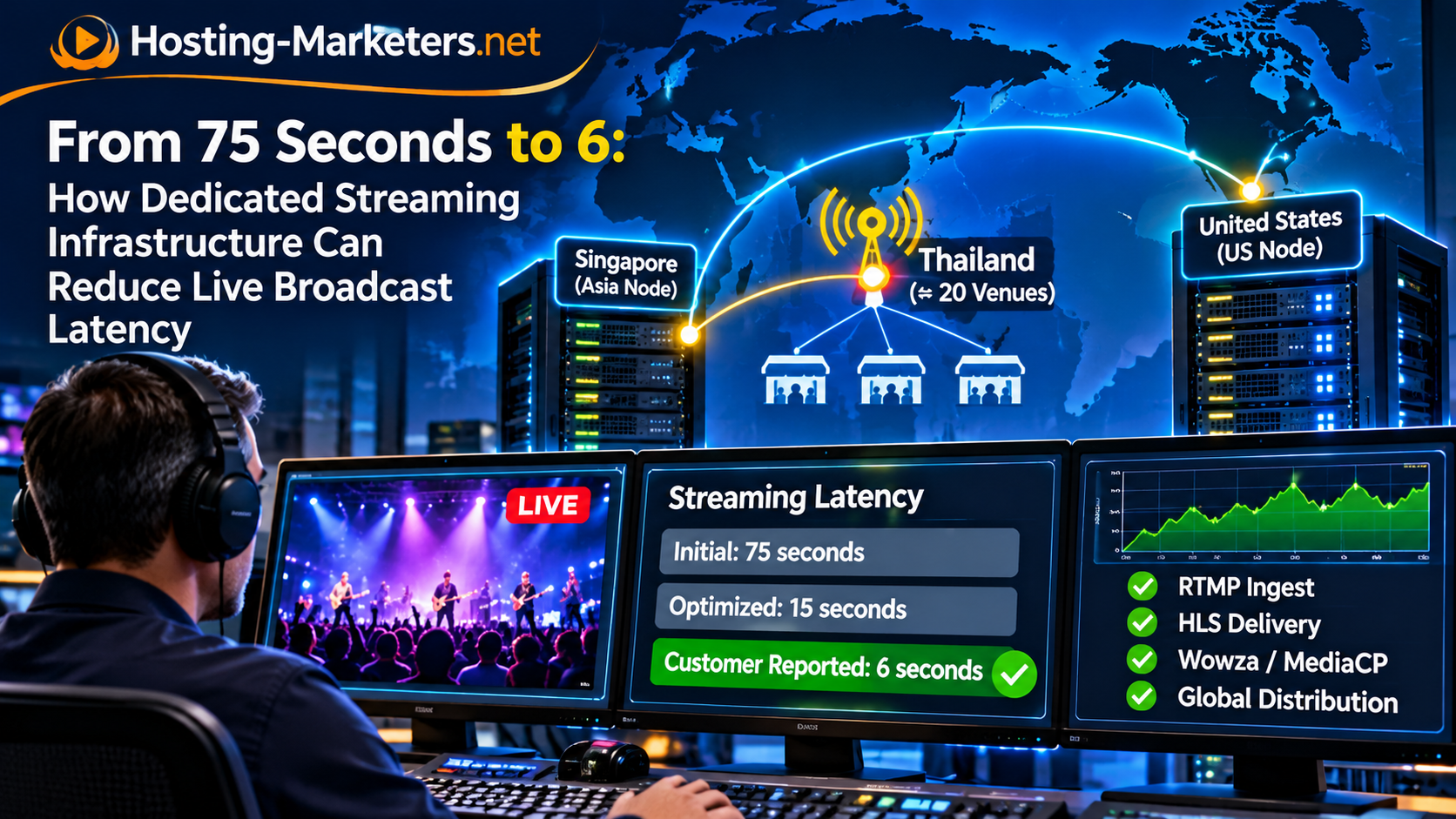
A professional broadcasting deployment serving approximately 20 entertainment venues in Thailand provides an interesting example of how streaming latency can be improved through infrastructure and configuration optimisation.
The operation uses dedicated streaming servers located in Singapore and the United States.
The geographical distribution of these servers supports international broadcasting requirements while providing infrastructure closer to different parts of the intended audience.
Initially, the streaming delay was approximately 75 seconds.
Following configuration changes and streaming infrastructure optimisation, the delay was reduced to approximately 15 seconds.
Further improvements eventually resulted in the customer reporting a delay of approximately six seconds.
| Optimisation stage | Approximate latency | Reduction from initial delay |
|---|---|---|
| Initial configuration | 75 seconds | — |
| Intermediate optimisation | 15 seconds | 80% |
| Customer-reported final result | 6 seconds | 92% |
The final six-second result was reported by the customer and should not be interpreted as an independently verified benchmark or a guaranteed outcome for other streaming deployments.
Nevertheless, the experience demonstrates how substantial improvements can be achieved by examining streaming configurations and infrastructure together.
Why geographical server location matters
Physical distance affects network communication.
Data travelling between Southeast Asia and North America must pass through international network infrastructure, including submarine fibre-optic cables and multiple routing systems.
Although modern fibre-optic networks are extremely fast, geographical distance introduces unavoidable propagation delays.
Network congestion, inefficient routing and packet loss can introduce additional problems.
A streaming server located in Singapore may provide more efficient connectivity to viewers in Thailand, Malaysia, Indonesia and neighbouring countries than a server located exclusively in North America.
However, geographical proximity alone does not guarantee superior performance. Network peering arrangements, internet service providers and international transit capacity also influence the quality of delivery.
Professional broadcasters should evaluate server locations according to actual audience distribution and network performance rather than simply choosing the least expensive available data centre.
RTMP ingestion and HLS delivery
Many professional broadcasting systems continue to use RTMP for transmitting live video from an encoder to a streaming server.
RTMP remains widely supported by broadcasting applications, hardware encoders and production systems.
However, modern browsers generally rely on other protocols for video playback.
HTTP Live Streaming, commonly known as HLS, is one of the most widely used delivery technologies.
HLS divides video into smaller media segments and provides a playlist that tells the video player which segments are available.
Apple provides extensive technical information through its official HTTP Live Streaming documentation.
A conventional streaming architecture may therefore use RTMP for ingestion and HLS for audience delivery.
The advantage of this approach is compatibility with a wide range of devices, including smartphones, tablets, computers and smart televisions.
The disadvantage is that segment generation and playback buffering can introduce additional latency.
How HLS segment duration affects latency
HLS segment duration is one of several important factors affecting streaming delay.
A player that waits for three complete six-second segments before beginning playback may introduce approximately 18 seconds of buffering before accounting for encoding, network transmission and other processing delays.
Reducing segment duration can reduce this component of latency.
| Segment duration | Illustrative buffer of three segments |
|---|---|
| 10 seconds | 30 seconds |
| 6 seconds | 18 seconds |
| 4 seconds | 12 seconds |
| 2 seconds | 6 seconds |
These figures are simplified examples rather than predictions of total end-to-end latency.
Shorter segments also introduce trade-offs. They can increase the frequency of HTTP requests and playlist updates, potentially creating additional server overhead.
Encoder keyframe intervals, player behaviour and network stability must also be considered.
Low-Latency HLS introduces additional mechanisms, including partial segments, to reduce delays while retaining the advantages of HTTP-based delivery.
The importance of streaming server software
Dedicated hardware provides the foundation for professional broadcasting, but streaming server software determines how incoming video is processed and distributed.
Platforms such as Wowza Streaming Engine provide tools for managing live streams, recording, transcoding and delivery through multiple protocols.
Administrators can configure streaming applications according to the requirements of individual broadcasters.
A live television station may prioritise continuous playback and compatibility across different devices.
An interactive broadcasting service may instead prioritise minimal delay.
A multi-location entertainment business may require a balance between low latency, stability and reasonably consistent playback across venues.
These different requirements demonstrate why there is no universal configuration suitable for every streaming project.
Does additional bandwidth reduce latency?
Increasing network capacity can improve streaming performance when the existing connection is congested.
However, upgrading from a 1 Gbps network connection to a 10 Gbps connection does not automatically reduce streaming latency by a factor of ten.
Consider a broadcasting server delivering 100 simultaneous streams at an average bitrate of 4 Mbps.
The combined outbound video traffic would be approximately 400 Mbps, excluding protocol overhead.
A well-provisioned 1 Gbps connection could potentially accommodate this workload with sufficient operational headroom.
If the main source of latency is a video player buffering several HLS segments, upgrading the network connection may produce little improvement.
Higher-capacity connections become particularly valuable when supporting larger audiences, multiple channels or substantial traffic fluctuations.
Network capacity should therefore be selected according to expected demand rather than treated as a direct measurement of streaming delay.
Monitoring a professional streaming deployment
Reliable broadcasting requires continuous observation of infrastructure performance.
Important operational measurements include CPU utilisation, network throughput, packet loss, memory consumption, encoder stability and video playback behaviour.
Monitoring should also include end-to-end latency measurements.
One practical testing method involves displaying a synchronised clock within the source broadcast and comparing it with the clock visible in the receiving video player.
Tests should be repeated using different devices, network connections and geographical locations.
This helps administrators distinguish between server-side problems and issues affecting individual viewers.
Performance should also be evaluated during periods of peak audience demand, rather than exclusively under ideal testing conditions.
Balancing low latency and broadcast reliability
The lowest possible latency is not necessarily the best configuration for every broadcaster.
Reducing buffering makes playback more sensitive to temporary network interruptions.
For an online television station, a slightly longer delay may be preferable if it provides more stable viewing.
Interactive applications may require WebRTC or other delivery technologies designed for much lower latency.
Professional streaming infrastructure should be configured according to the actual needs of the business.
The objective is to achieve an appropriate balance between latency, video quality, compatibility, infrastructure cost and operational reliability.
Conclusion
International live broadcasting requires careful coordination between encoders, streaming servers, network infrastructure and playback applications.
The experience of reducing streaming latency from approximately 75 seconds to a customer-reported six seconds illustrates the potential benefits of systematic optimisation.
Dedicated infrastructure provides the flexibility necessary to investigate and address many of the factors affecting streaming performance.
However, hardware alone cannot guarantee low latency.
The most effective approach combines suitable geographical server locations, appropriate network capacity, carefully configured streaming software and continuous performance monitoring.
For professional broadcasters, understanding these relationships is essential to building a reliable and scalable international video delivery platform.

